8 Best Headphones for BTE Hearing Aids (October 2026)
The best headphones for behind-the-ear hearing aids include the SuperEar SE5000 Hearing Amplifier for Seniors for nearby conversations, the Williams Sound PockeTalker Ultra DUO Sound Amplifier for TV by cable, and the Williams Sound Pocketalker 2.0 Hearing Amplifier for simple listening.
On this page (8 sections)
- How we chose headphones for BTE hearing aids
- What matters when choosing headphones for BTE hearing aids?
- Which headphones for BTE hearing aids fit each use?
- How can you check the fit without pressing your hearing aids?
- How do you set up TV headphones with your hearing aids?
- How should you care for and use the headphones?
- What common headphone mistakes should BTE wearers avoid?
- Which headphones should you choose for BTE hearing aids?
The best headphones for BTE hearing aids are over-ear models that fit around your ears without pressing on the devices. For TV, compare connection options and cup fit; for nearby conversation, a personal sound amplifier may suit you better.
Behind-the-ear (BTE) hearing aids sit behind the ear, so the headphone cushion and headband can affect comfort. Caregivers comparing this style for a child can read BTE hearing aids for children.
A cup that rests on the ear may press on the aid, tubing or controls, while an over-ear cup has a better chance of surrounding the ear.
No shape guarantees a fit for every person. Try headphones with your own hearing aids in place, and stop if the cup creates pressure, discomfort or feedback.
The products here serve two different purposes. For a closer comparison, read hearing aids vs. earbuds and headphones.
TV headphone systems send audio to their own headset, while personal sound amplifiers use a microphone to pick up nearby sound and send it to an included listening option.
If you want TV sound through your hearing aids, consider a compatible streamer instead of a separate headset. Compare how to connect hearing aids to a TV and the best TV streamers for hearing aids.
Our picks at a glance
-
1
 Best for nearby conversations
SuperEar SE5000 Hearing Amplifier for Seniors
9.7/10 our score
See it on Amazon -
2
 Best for TV by cable
Williams Sound PockeTalker Ultra DUO Sound Amplifier
9.6/10 our score
See it on Amazon -
3
 Best for simple listening
Williams Sound Pocketalker 2.0 Hearing Amplifier
9.3/10 our score
See it on Amazon
- 4
 Check it
Swiitech Wireless TV Headphones for Seniors
Best for lighter TV wear - 5
 Check it
LEVN Wireless Headphones for TV Watching
Best for marathon viewing - 6
 Check it
IROGER Hearing Amplifier Rechargeable Hearing Device
Best for portable amplification - 7
 Check it
SIMOLIO Sound Amplified Wired Headphones with Extra
Best for a long cable - 8
 Check it
SIMOLIO Bluetooth Compatible Wireless TV Headphones
Best for balanced TV sound
How we chose headphones for BTE hearing aids
The best headphones for BTE hearing aids need a plausible fit around behind-the-ear devices and a connection that suits the sound source. We compared the stated fit style, included listening options, controls and TV connections.
Over-ear designs are the most relevant starting point for clearance, but “over-ear” alone does not confirm that the cup is wide or deep enough for your ears and hearing aids. The available product descriptions do not give measured cup clearance, so use fit as a personal check.
Some picks are personal sound amplifiers rather than conventional headphones. They earn a place because they include listening headsets or earbuds and can help with nearby conversation, but they do not all provide a direct TV feed.
What matters when choosing headphones for BTE hearing aids?
Start with fit, then choose a connection that works with your listening source. A headset that has the right ports or controls is still a poor choice if it presses on your hearing aids.
Consider these points before you buy:
- Earcup shape and depth: The cushion should surround the outer ear without pushing the hearing aid, tubing or controls. Product names may say “over-ear,” but fit varies by person.
- Pressure: A tight headband can press the cups into your ears. A gentle, stable fit is more useful than a strong seal that becomes uncomfortable.
- Listening source: Choose a TV system for television sound, or an amplifier with a microphone for nearby conversation. These are different ways of listening.
- TV ports: Check the television for optical, RCA or 3.5 mm audio output before choosing a transmitter or wired headset. Optical-only TVs may need a converter for some wired headphones.
- Personal controls: Volume, tone and left/right balance controls can make it easier to adjust sound without changing the hearing aid settings.
- Wired or wireless use: A cable keeps the headphones connected directly, while a transmitter-based system lets you move without a cord. Think about your usual seat and whether you want to get up while listening.
For more headset options, see our guide to headsets for hearing aid users. If you are still learning how a BTE device sits and works, read what a BTE hearing aid is and compare BTE and RIC hearing aids.
Which headphones for BTE hearing aids fit each use?
The right pick depends on whether you want amplified nearby sound, private TV listening or a wired connection. The products below make different trade-offs, so match their features to your routine and confirm comfort with your own devices.
| Product | Best for | Use | Included listening options | TV connection | Our score |
|---|---|---|---|---|---|
| SuperEar SE5000 Hearing Amplifier for Seniors | nearby conversations | Ambient sound amplification | Stereo headphones and earbuds | No direct or wireless connection | 9.7 |
| Williams Sound PockeTalker Ultra DUO Sound Amplifier | TV by cable | Conversation and TV listening | Headset and single earbud | 9.6 | |
| Williams Sound Pocketalker 2.0 Hearing Amplifier | simple listening | Conversation and personal listening | 9.3 | ||
| Swiitech Wireless TV Headphones for Seniors | lighter TV wear | 9.2 | |||
| LEVN Wireless Headphones for TV Watching | marathon viewing | 9.1 | |||
| IROGER Hearing Amplifier Rechargeable Hearing Device | portable amplification | Portable sound amplification | 8.8 | ||
| SIMOLIO Sound Amplified Wired Headphones with Extra | a long cable | 8.6 | |||
| SIMOLIO Bluetooth Compatible Wireless TV Headphones | balanced TV sound | 8.1 |
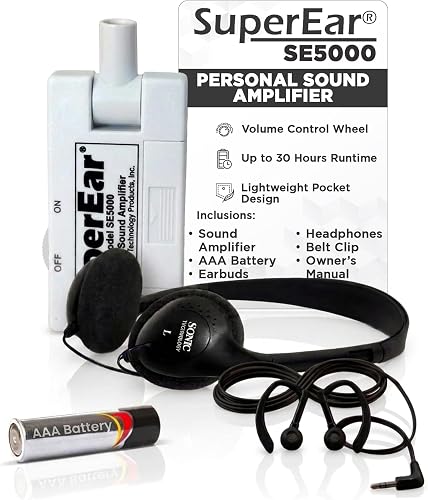
SuperEar SE5000 Hearing Amplifier for Seniors: Best for nearby conversations
- Captures and amplifies ambient sound
- Includes stereo headphones and earbuds
- Tactile volume wheel
- Portable handheld unit
A handheld amplifier with included headphones and earbuds offers two listening styles for nearby sound. It does not connect to a TV directly or wirelessly.
Pros
- Includes headphones and earbuds
- Tactile volume control
- Portable with belt clip
Cons
- Does not connect directly to a TV
- Amplifies ambient sound rather than providing a TV audio feed
The SuperEar SE5000 is a personal sound amplifier for nearby conversations and everyday listening. It includes stereo headphones and discreet stereo earbuds, giving you two ways to listen while wearing BTE aids.
A tactile wheel controls volume, and a swivel microphone captures ambient sound. SuperEar states up to 30 hours of battery life with moderate to heavy use.
Choose it if you want a portable amplifier for conversation and the flexibility to switch between headphones and earbuds. Skip it if you need a wireless or direct TV connection, because it can amplify sound near TV speakers but does not connect to the television.
Williams Sound PockeTalker Ultra DUO Sound Amplifier: Best for TV by cable
- Includes listening headset and single earbud
- TV listening cord
- External volume and tone controls
- Removable microphone
The PockeTalker Ultra DUO includes a TV listening cord and a choice of headset or single earbud. Its separate volume and tone controls let you adjust the sound.
Pros
- Headset and earbud included
- TV listening cord included
- External volume and tone controls
Cons
- Uses two AAA batteries that are not included
- The headset may press on a BTE aid, so check fit
The Williams Sound PockeTalker Ultra DUO combines a personal amplifier with a listening headset, single earbud and TV listening cord. It suits someone who wants an option for conversation and a cable-based TV setup.
Its external volume and tone controls offer two ways to adjust sound. The unit uses two AAA batteries, which are not included.
Choose it if you want a choice between a headset and a single earbud, plus a TV listening cord. Skip the headset if it presses on your BTE aids; the included earbud may be a more comfortable option, if it fits your needs.
Williams Sound Pocketalker 2.0 Hearing Amplifier: Best for simple listening
- Amplifies nearby sound
- Includes headphones and earbuds
- Two AAA batteries included
- 3.5 mm audio jack compatibility
This personal amplifier is designed for nearby conversation and includes headphones and earbuds. It may suit you if you want a separate listening option, though fit over BTE aids depends on earcup clearance.
Pros
- Headphones and earbuds included
- Volume and tone controls
- Batteries included
Cons
- Fit with BTE aids depends on the included headphone shape
- Not a wireless TV headphone system
The Williams Sound Pocketalker 2.0 is designed for nearby sound and comes with headphones and earbuds. Its separate volume and tone controls let you adjust the listening experience, and its 3.5 mm jack works with compatible audio devices.
Two AAA batteries are included. The description does not specify the included headphones’ cup clearance, so wearing BTE aids calls for a careful fit check.
Choose it if you want a simple personal amplifier with both headphone and earbud options. Skip it if your priority is a wireless TV system or you need confirmed room around a particular BTE aid.
Swiitech Wireless TV Headphones for Seniors: Best for lighter TV wear
- Over-ear headphones
- Soft breathable earcups
- Optical, AUX and RCA inputs
- Bluetooth support
Over-ear placement and soft earcups make this a TV option to consider when you wear BTE aids. Check that the cups fit around your ears without pressing on the aids.
Pros
- Over-ear design
- Multiple TV connection options
- Can pair with a phone or computer by Bluetooth
Cons
- Bluetooth connection requires a compatible TV
- Earcup clearance varies by head and hearing aid
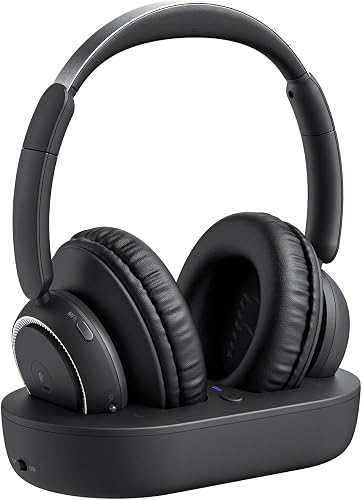
Swiitech’s CH-211 is an over-ear wireless TV headphone system with soft, breathable earcups. It connects to a TV through optical, AUX or RCA, and can use Bluetooth when the TV supports it.
The charging base sends sound to the headphones, which can also pair with a phone or computer. Swiitech states up to 45 hours of use on one charge.
Choose it if you want a dedicated TV headset with several common connection choices and a lightweight design. Skip it if you need a confirmed fit around your hearing aids, since earcup clearance is not specified; check that the cups surround your ears without pressing the devices.
LEVN Wireless Headphones for TV Watching: Best for marathon viewing
- Over-ear headphones
- Optical, AUX and RCA cables
- Transmitter charging base
- Up to 65 hours of battery life
The transmitter supports common TV audio outputs, and the over-ear cups may work for BTE wearers if they clear the aids comfortably. The brand states up to 65 hours of battery life.
Pros
- Three cable options for TV
- Over-ear design
- Charging base stores the headphones
Cons
- Fit and pressure depend on earcup size and head shape
- Requires a suitable TV output or Bluetooth support
LEVN’s wireless TV headphones include a transmitter charging base and optical, AUX and RCA cables. The over-ear design makes them worth considering for BTE wearers, provided the cups clear the aids comfortably.
LEVN states that the headphones run for up to 65 hours on a charge. They can also connect to Bluetooth-enabled devices, and the transmitter offers a straightforward TV connection when your television has a matching audio output.
Choose this model if you want a long stated battery life and a base that stores and recharges the headphones. Skip it if the earcups press against your aids or if your TV has no compatible audio output and does not support Bluetooth.
IROGER Hearing Amplifier Rechargeable Hearing Device: Best for portable amplification
- Directional microphone
- One-knob volume control
- Rechargeable battery
- Sound amplifier included
A compact amplifier with a directional microphone offers an alternative to a TV headphone system. The product data does not specify headphone inclusion or fit over BTE aids.
Pros
- One-knob control
- Portable design
- Rechargeable
Cons
- Headphone clearance for BTE aids is not specified
- Does not describe a TV transmitter connection
IROGER’s rechargeable sound amplifier has a directional microphone and a one-knob control for power and volume. Its portable format is aimed at nearby speech, rather than providing a dedicated TV headphone connection.
IROGER states that it charges in 1 hour and provides up to 120 hours of use. The included components specify a sound amplifier, but do not identify headphones or describe how it fits with BTE hearing aids.
Choose it if your main need is portable amplification and a simple control. Skip it if you want a complete headphone setup or a TV transmitter, because those connections and included listening pieces are not specified.
SIMOLIO Sound Amplified Wired Headphones with Extra: Best for a long cable
- Over-ear wired headphones
- 18 ft coiled cord
- Tone control
- 3.5 mm and RCA connections
The long coiled cord and tone control suit TV listening from a seat away from the screen. Its over-ear cups still need to clear your BTE aids without pressure.
Pros
- Long coiled cord
- Tone control
- RCA converter cable included
Cons
- Wired rather than wireless
- Optical-only TVs require a separate digital-to-analog converter
SIMOLIO’s SM-905TV is a wired, over-ear TV headset with an 18 ft coiled cord, tone control and volume control. The cord can stretch across a room from the TV, and tone adjustment is intended to clarify dialogue.
It works with a 3.5 mm audio output or the included RCA converter cable. A TV with only optical or coaxial audio output needs a separate digital-to-analog converter.
Choose it if you prefer a wired connection, want a longer reach from the TV and can connect through a compatible output. Skip it if you need wireless listening or your BTE aids make the earcups feel tight.
SIMOLIO Bluetooth Compatible Wireless TV Headphones: Best for balanced TV sound
- Over-ear TV headphones
- Three tone presets
- Left/right balance control
- Optical, RCA and AUX connections
Tone presets and balance controls offer more ways to adjust TV sound. Check whether the earcups sit around your BTE aids without pressing them, and use the transmitter for TV listening.
Pros
- Tone presets and left/right balance control
- Multiple TV input options
- Transmitter intended for TV listening
Cons
- Fit depends on earcup clearance
- TV Bluetooth alone may introduce audio lag
SIMOLIO’s SM-825D Pro pairs over-ear headphones with a TV transmitter and Bluetooth mode. Three tone presets and left/right balance control give you ways to adjust TV sound to your preferences.
The system connects to a TV through optical, RCA or 3.5 mm AUX. SIMOLIO describes a bypass feature that can let headphones and external speakers play at the same time when the TV setup supports it.
Choose it if tone and left/right balance adjustments are useful and you want a transmitter for TV listening. Skip it if you need confirmed earcup clearance or expect to use the TV’s Bluetooth alone for lip-synced audio; the transmitter is the recommended TV route.
How can you check the fit without pressing your hearing aids?
Put your BTE hearing aids on as usual, then position the headphones gently over your ears. The cups should sit around the ears rather than resting on the devices or pushing their tubing and controls.
Check the fit in a few simple steps:
- Place each cup over the ear without forcing the headband down.
- Feel around the edge of the cushion for pressure on the hearing aid or tubing.
- Turn your head and open your jaw to see whether the cups shift or pinch.
- Play sound at a comfortable level for a short period.
- Remove the headphones if you feel soreness, pressure or feedback.
A mirror can help you see whether the hearing aid has been displaced. If the cup cannot sit around the ear comfortably, try a different headphone shape or use an earbud or streamer that suits your listening goal.
How do you set up TV headphones with your hearing aids?
Connect a TV headphone system to one compatible TV audio output, then confirm the television’s sound settings match that connection. Start with the cable and port named for your system, and avoid connecting multiple audio inputs at once.
For a transmitter-based model, place the base near the TV and connect it through optical, AUX or RCA when supported. Some systems may need the TV’s digital output set to PCM or stereo, rather than an automatic or passthrough format.
For the SIMOLIO wired headset, use a 3.5 mm output or the included RCA converter cable. If your TV has only optical or coaxial output, plan on a separate digital-to-analog converter.
After connecting, test the sound before settling in. If there is no audio, check that the cable is in an audio output port, the TV is set to the matching output, and the transmitter or headphones are powered on.
Bluetooth may be an option for compatible TVs, but dedicated transmitters are often the simpler choice for these TV systems. If your goal is to hear through your hearing aids instead of through separate headphones, use a compatible hearing-aid streamer and follow its pairing steps.
For speech sent from a separate microphone, see remote microphones for hearing aids. For microphone options, see Bluetooth microphones for hearing aids.
How should you care for and use the headphones?
Keep the headphones and hearing aids dry, clean and stored so the cables or devices do not get pulled. Careful handling helps avoid putting pressure on the hearing aids when you take the headset on or off.
Remove the headphones before adjusting or removing a hearing aid. This reduces the chance of catching tubing or shifting the device as you lift the headband.
Wipe headphone cushions with a soft, dry cloth and follow the manufacturer’s care directions for any material-specific cleaning. Keep moisture and cleaning liquids away from the hearing aids, microphone openings and electronic parts.
For wired models, unplug by holding the connector rather than pulling the cable. Coil long cords loosely, and keep the wire clear of chair wheels and walkways.
For wireless models, return the headset to its charging base or use its recommended charging method after listening. If a rechargeable headset stops working, check its charge and connection before changing TV settings.
Keep listening volume comfortable. A personal sound amplifier or headphone volume control can make sound louder, but turning it up to overcome poor fit or a bad connection does not solve the underlying issue.
What common headphone mistakes should BTE wearers avoid?
The most common mistake is choosing by connection features before checking physical fit. A convenient transmitter cannot compensate for a cup that presses on the hearing aid.
Avoid these missteps:
- Assuming every over-ear cup clears BTE aids: “Over-ear” describes placement, not the space inside the cup. Try the fit on your own ears and devices.
- Using on-ear pressure as a seal: Pads resting on the ear can press directly on the aid. Stop if the headset shifts the device or causes discomfort.
- Buying before checking TV ports: Identify the available audio output first. Optical-only TVs may need a converter with some wired models.
- Connecting two audio cables at once: Choose a single input such as optical or AUX and set the TV to match.
- Mistaking an amplifier for a TV headset: A personal sound amplifier captures ambient sound. It is not automatically a direct TV audio system.
- Turning up the volume to fix a poor fit: First check the source, connection and controls. Keep volume at a comfortable level.
- Ignoring battery or charging needs: Check whether batteries are included, whether they are replaceable, or whether the headset uses a charging base.
If a hearing aid whistles or feels displaced after putting on headphones, take the headset off and reseat the aid. For ongoing fit or feedback problems, your hearing care professional can help check the device position.
Which headphones should you choose for BTE hearing aids?
Choose by listening goal first, then confirm fit and connection. For nearby conversation, the SuperEar SE5000 or either PockeTalker offers an amplifier with included listening options; for TV, compare the Swiitech, LEVN or SIMOLIO headset systems.
Pick the Swiitech if you want an over-ear TV headset with several connection options and soft, breathable earcups. Pick the LEVN if a long stated battery life and a charging base matter most, or the SIMOLIO wired headset if you prefer a cable and tone control.
Choose the SIMOLIO SM-825D Pro if its tone and balance controls match your needs. For conversation away from the TV, consider the SuperEar for its headphones and earbuds, the PockeTalker Ultra DUO for its headset and TV cord, or the Pocketalker 2.0 for a simple personal amplifier setup.
If you want television sound delivered through your hearing aids, compare a compatible streamer instead of choosing a separate headphone system. The best headphones for BTE hearing aids are the ones that clear your devices comfortably and connect to the source you actually use.
Our top 3 picks at a glance
-
1
Best for nearby conversations
SuperEar SE5000 Hearing Amplifier for Seniors
9.7/10 our score
See it on Amazon -
2
Best for TV by cable
Williams Sound PockeTalker Ultra DUO Sound Amplifier
9.6/10 our score
See it on Amazon -
3
Best for simple listening
Williams Sound Pocketalker 2.0 Hearing Amplifier
9.3/10 our score
See it on Amazon
Frequently asked questions
Can you wear over-ear headphones with BTE hearing aids?
Often, if the earcups fully surround your ears and don't press the hearing aids against them. Fit depends on the size and shape of your ears, hearing aids and headphone cups.
Try a short listening session at a comfortable volume, then stop if you feel pressure or discomfort.
Are on-ear or over-ear headphones better for BTE hearing aids?
Over-ear headphones are often easier to fit because their cups can surround the ear and hearing aid. On-ear pads rest on the ear, which may press on a BTE device.
Cup size and padding still vary, so check the fit while wearing your aids.
Can TV headphones connect to hearing aids?
Some hearing aids connect to a TV through a compatible streamer, while TV headphones send sound to their own headset. The right choice depends on whether you want the audio through your hearing aids or separate headphones.
For the hearing-aid route, see What Is a Hearing Aid Streamer?.
How should I check headphone fit with BTE hearing aids?
Put your hearing aids on as usual, then place the headphones gently over your ears. Check that the cups surround the ears and don't push the aids, tubing or controls.
Keep the volume comfortable and remove the headphones if you notice pressure, feedback or discomfort.